
The Charity Lot for Destitute Instructors in Public Schools
Crown Hill Cemetery has a long history of working with groups to provide space for group burials. These individuals, either by religion, organizational membership, institutional living arrangements, or other reasons, are buried in lots together. These spaces are individual burials, not mass graves; each interment made at the time of death of the person. Some group burials are a result of the purchase of the lots and that organization selling back the spaces to their members. In other cases, the Crown Hill Board of Corporators donated the lots to institutions for their use.
One such lot is the Charity Lot for Destitute Instructors in Public Schools.
Why is there a lot for destitute instructors at Crown Hill Cemetery? And are there really teachers buried in the lot? All great questions — since the 1930s!
Articles can be found in the 1937 Indiana Magazine of History about a lot for destitute teachers in Crown Hill Cemetery. Historian Emmitt Rice even read his article at the Indiana Historic Conference in Indianapolis in 1937. Documents in the Crown Hill Foundation Archives do note that Section 3, Lot 30 is a “Charity Lot for Destitute Instructors in Public Schools.” Starting as early as 1874 with Ella Coffin and ending in 1951 with Alice Keatley, eight people, including Alexander Ralston, are noted as being in the lot.
Between the article written by Rice in 1937 and records available today, we know:
*Ella (Eliza) P. Coffin (d. 30 May 1870) was a teacher and principal in 2nd and 4th Wards as early as 1868. While she died in 1870, she was not originally buried in Crown Hill. She was moved into the cemetery four years later; her original burial location is unknown. Dr. Shortridge (also buried in Crown Hill Cemetery), Superintendent of Indianapolis Schools, paid for the cost of her burial.
*Anna M. Tyler (d. 11 Aug 1870) was a teacher and principal starting in 1868 at Intermediate High School. While she died in 1870, she was not originally buried in Crown Hill. She was moved into the cemetery four years later; her original burial location is unknown. Dr. Shortridge paid for the cost of her burial.
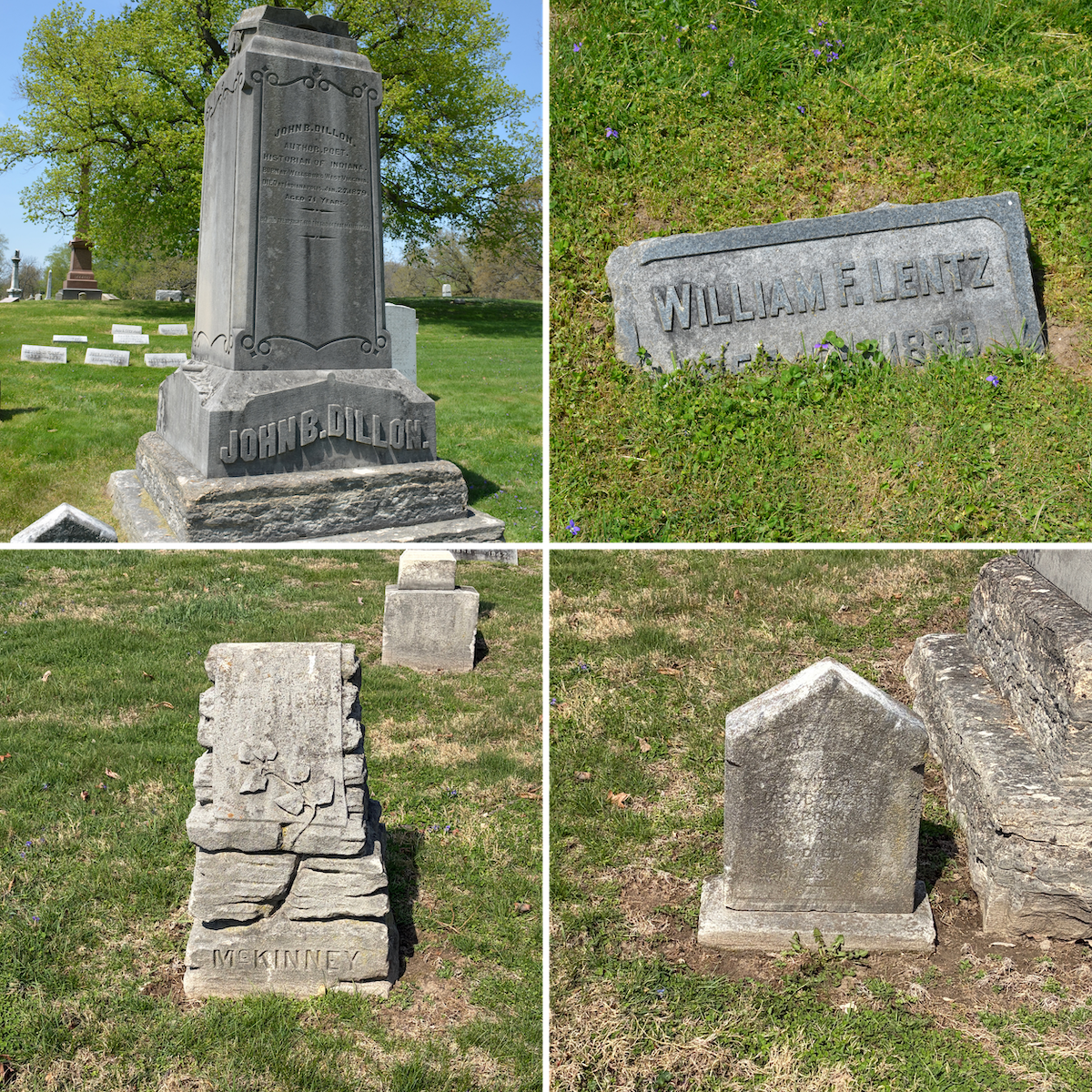
*George McKinney (d. 3 Sept 1889) was a carpenter and laborer in the city. He is found in the police “blotter” in the newspaper for malicious trespass.
*William F. Lentz (d. 4 Oct 1889) was born in Pennsylvania but was living in Indianapolis by the time he was 13, working in a rolling mill. The family soon moved to Martinsville, where William worked on a farm. By the late 1880s, he was back living in Indianapolis and working first as a firefighter and then as a laborer.
*Catherine Messing (d. 23 Jan 1890) was born in Indiana and was a homemaker.
*John B. Dillon (1808-27 Jan 1879) This West Virginia native is considered the father of writing of Indiana history. While in West Virginia, he worked as a printer and poet. He relocated to Logansport, IN, where he studied law and then moved to Indianapolis in 1842. While in Indianapolis he became the Indiana State Librarian (1845-1851), assistant secretary of the state, secretary of state agricultural society, and recorder of the state’s history, writing a history of Indiana as early as 1843.
*Alice Keatley (6 Dec 1874-29 Aug 1951) – Born in England, Alice came to Indianapolis when she was 5. She attended Shortridge High School, where she also taught for31 years. She attended the Indianapolis Normal College and Butler University.
